Gymnasium Thomaeum
Founded in 1659 and named after the mystic Thomas à Kempis, the Thomaeum is one of Germany's oldest grammar schools and still an active school today.
since 1659
In the middle of Kempen stands a school whose roots reach back to 1659. The Gymnasium Thomaeum is one of the oldest grammar schools in Germany and carries the name of the town's best-known son.
At a Glance
- Founded
- 1659
- Named after
- Thomas à Kempis, a mystic born in Kempen around 1380
- Status today
- municipal grammar school, still in operation
- Distinctions
- "Europaschule" (since 2009), certified as a MINT-friendly school
- Catchment area
- traditionally far beyond Kempen – including Grefrath, Straelen, Wachtendonk, Hüls and St. Tönis
- Location
- in the former teachers' seminary since 1925
- Oldest item
- school bell from 1690, on display inside the school
Age comparison
Age compared with other places in Kempen.
History
The school began in 1659 under church administration. Only in 1802 did Joseph Bister become its first secular headmaster. Its name changed several times over the centuries, but one thing stayed constant: since 1778 the school has received financial support from the "Eternal Foundation" of Kempen citizen Gerhard Arnold Mühlen. The catchment area was always wide as well – pupils came from Kaldenkirchen, Lobberich, Straelen, Wachtendonk, Wankum, Grefrath, Hüls, St. Tönis and other neighbouring communities.
The Namesake: Thomas à Kempis
The school's patron was born in Kempen around 1380 and worked as a mystic. His book "The Imitation of Christ" was, after the Bible, the most widely circulated text of the late Middle Ages – carrying the name of the small Lower Rhine town far beyond the region.
Changing School Buildings
Over the centuries the Thomaeum moved repeatedly, passing through a good deal of Kempen's historic building stock: lessons were held in the old bursa, in the Franciscan monastery and in Kempen Castle, and since 1925 in the former teachers' seminary. A find from 1976 ties those stations together: the school bell of 1690, inscribed "Gymnasium Thomae de Kempis", turned up in a private attic. It is on display in the school today.
Environment, Technology and Music
The school took up environmental questions early on: a solar installation from 1993 sits on the Thomaeum's roof, and pupils regularly enter competitions such as "Jugend forscht" with ideas for sustainable technology and green electricity. The school has left musical traces too – the band Castle of Aargh grew out of the Thomaeum's student body, and some of its members now work as professional musicians, among them Arnt Cobbers.
The Thomaeum Today
In 2009 the school celebrated its 350th anniversary and was certified as a "Europaschule" by the state government. In keeping with that, exchange programmes run with China, Belgium, England, Spain, Poland and France, and pupils can earn the Diplôme d'études en langue française. The school is certified as MINT-friendly and takes part in national competitions, from the Känguru maths contest and the German Mathematical Olympiad to the student competition in political education. There is also a school orchestra, award-winning theatre work (Spectacolo Prize in 2006 and 2007, plus the Europe-wide premiere of the musical "Hairspray"), and social engagement such as the HOKISA charity bike tour for action medeor, an annual social work placement and a St. Martin's fundraising campaign. Since September 2005 the student café CaTho has been open, alongside a supporters' association, a wide range of clubs from art and science to computing, and the Thomaeer Prize awarded by the alumni association for outstanding achievement.
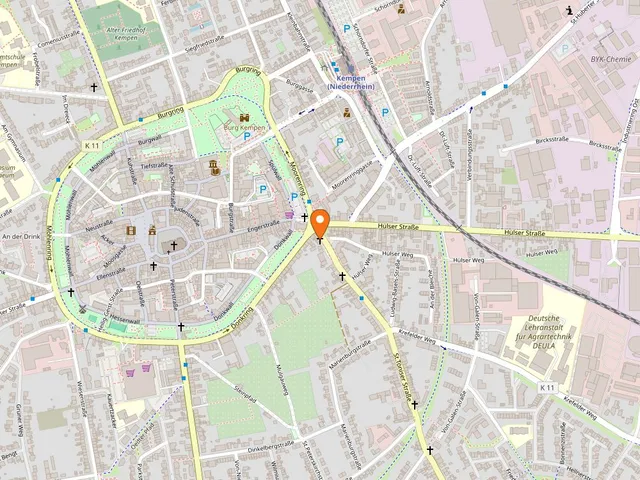
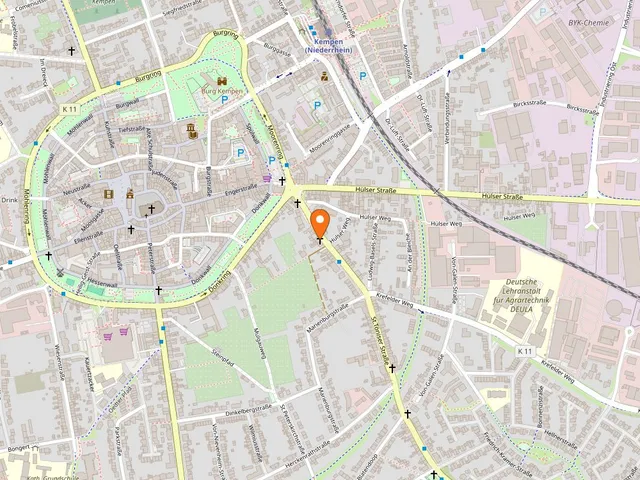
Map
Blue dots: other places nearby — tap to explore.
Address
Am Gymnasium 4
47906 Kempen
Hours
Mo: 07:30–16:00
Di: 07:30–16:00
Mi: 07:30–16:00
Do: 07:30–16:00
Fr: 07:30–15:00
Contact
You might also like — related or nearby
Comments
- Loading comments…
Sources & links
- Official website
- Official website (retrieved 2026-08-06)
- Wikidata (retrieved 2026-07-15)
- Wikipedia (retrieved 2026-07-15, rev 267261986)
Auto-generated, last verified: 2026-07-15
How this page is made
This page draws on open sources — Wikipedia, Wikidata, official websites and the city’s open data. Every statement is checked against the sources linked here, and pages are refreshed regularly.
Spotted a mistake anyway? Tell us below — we read every submission.