St. Hubertus (St. Hubert)
Neo-Gothic brick church in Kempen-St. Hubert with a Gothic tower from 1524 and a Klais organ hailed by experts as a tonal monument.
In the Kempen district of St. Hubert (Kreis Viersen, North Rhine-Westphalia) stands the Roman Catholic parish church of St. Hubertus, dedicated to St. Hubert of Liège.
At a Glance
- Type
- Roman Catholic parish church
- Location
- St. Hubert district of Kempen (Kreis Viersen, NRW)
- Built
- 1846–1850, attached to a tower dating from 1524
- Style
- Three-aisled, five-bay Neo-Gothic brick hall church
- Heritage status
- No. 16 on Kempen's list of listed monuments
- Organ
- Klais organ of 1930 (Opus 760)
History
A chapel in St. Hubert is first documented in 1447, subordinate to the parish of St. Mariä Geburt in Kempen; it gradually gained the right to celebrate Mass and received a new bell tower in 1524, which still stands today. On 1 October 1790, the Archbishop of Cologne, Maximilian Franz of Austria, raised St. Hubert to an independent parish, turning the chapel into a full parish church.
Construction of Today's Church
By the mid-19th century the medieval building had become too small, so the nave was demolished, leaving only the 1524 tower. The cornerstone for the new building was laid on 2 June 1846, with consecration following on 8 December 1850, based on plans by district architect Lüdke of Kempen and executed under Krefeld's city architect Heinrich Johann Freyse. Between 1900 and 1902 the Gothic tower was raised by one storey to designs by Caspar Clemens Pickel and Wilhelm Pauen of Düsseldorf.
The Organs
Earlier instruments included an organ by Johann Heinrich Titz (1793) and a rebuild by Nolting & Sohn (1830/31), later expanded by Kempen organ builder Chrysanth Henseler; this instrument lost its pipes to a metal donation drive in 1917 and was dismantled in 1930. The current Klais organ (Opus 760) was a gift to pastor Theodor Bers for his 80th birthday, built to a reduced 18-register design and inaugurated on 23 November 1930. Despite wartime damage and fluctuating conditions after 1945, a planned replacement around 1980 was averted when Aachen organ consultant Viktor Scholz classified its pneumatic cone chests as a tonal monument worth preserving; the organ was restored by Weimbs in 1982 and again by Verschueren Orgelbouw in 2018.
Parish Life Today
A Weimbs chest positive, originally brought in during the 1982 restoration to accompany services, was later purchased by the parish and now stands in the crypt, also serving as a continuo instrument. Since 2003, Thomas Eicker has served as parish priest, following a long line of pastors dating back to 1790; the parish today also includes Voesch, Bell, Degelsheide, Escheln, and parts of several neighboring hamlets.
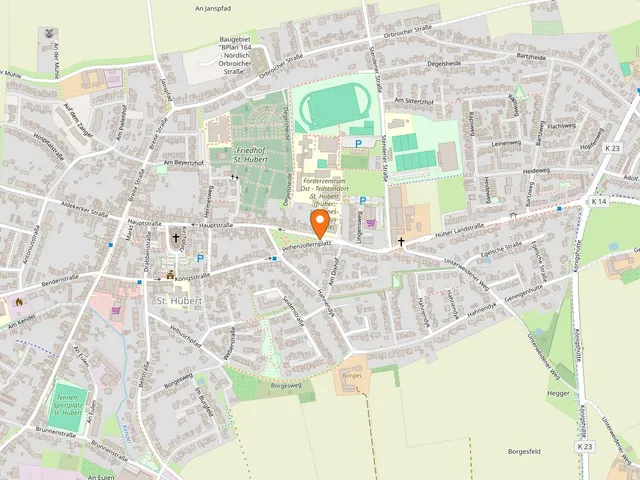
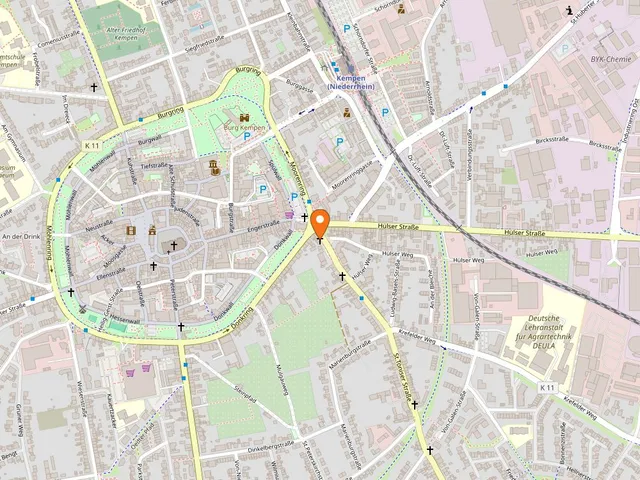
Map
Blue dots: other places nearby — tap to explore.
Address
Hauptstraße 21
47906 Kempen
You might also like — related or nearby
Comments
- Loading comments…
Sources & links
- Official website
- Wikidata (retrieved 2026-07-06)
- Wikipedia (retrieved 2026-07-06, rev 262998126)
- Official website (retrieved 2026-07-06)
- openstreetmap.org (retrieved 2026-07-06)
Auto-generated, last verified: 2026-07-06
How this page is made
This page draws on open sources — Wikipedia, Wikidata, official websites and the city’s open data. Every statement is checked against the sources linked here, and pages are refreshed regularly.
Spotted a mistake anyway? Tell us below — we read every submission.