St. Antonius (Tönisberg)
Neo-Gothic brick church of 1894, incorporating the 47-metre west tower of its predecessor building.
St. Antonius is a Roman Catholic church in Tönisberg, a district of Kempen in the Lower Rhine's Viersen district. The neo-Gothic brick church is a protected historic monument.
At a Glance
- Type
- Roman Catholic church, neo-Gothic brick
- Location
- Tönisberg district, Viersen district
- Built
- 1894
- Status
- Protected historic monument
- Tower
- 47 m west tower, retained from the previous church
- Highlight
- Choir windows depicting the life of St. Anthony, designed by Friedrich Stummel
Chapel and Predecessor Building
A chapel called "Sanct Antonius am Berghe" already stood at Ryckendael in the early 14th century, giving the village its later name. It held altars dedicated to St. Anthony and St. Cornelius, and in 1439 Duke Arnold of Guelders donated sixty morgens of land for the upkeep of a priest. The chapel served as a mortuary in the 19th century until it burned down in 1888. After the parish was founded, construction of a 30-metre-long, 7-metre-wide church began in 1537; it later received a Baroque high altar of the Ascension in 1662, plus two side altars for St. Anne and the Immaculate Mother of God. Grave slabs of clergy and the crypts of local noble families, who also had their own pews, once lay within the church.
New Construction
Pastor Heinrich Laakmann, installed in 1891, pushed forward a new building; the old church was largely demolished in 1893 under master builders Bernhard and Johann Laakmann. Only the tower survived as a projecting west tower, raised to 47 metres and re-clad in brick to match the nave. The foundation stone was laid in April 1894 in the choir area, on the site of the former cemetery, and the church was already in use by December. The building measures 31.5 metres in length, with widths of 12.1 metres in the nave, 18.1 metres in the transept, and 9.5 metres in the choir, plus an interior height of 11.5 metres beneath the ribbed vaulting. The old organ and pews were used temporarily. Bishop Hermann Jakob Dingelstad consecrated the building on 17 July 1898.
Furnishings
Following the liturgical reform of the Second Vatican Council, Pastor Wiegels redesigned the interior: Karl Franke created the bronze altar facing the congregation, depicting scenes from the Easter story, along with an ambo and tabernacle. The high altar's retable was moved to the choir's rear wall; the high altar itself was restored by 2005 and is framed by choir stalls, while the old pulpit was removed. The 1919 murals by Tönisberg church painter Karl Heil were largely uncovered again during restoration between 1982 and 1991. The three figurative choir windows of 1898/99, depicting the life of St. Anthony, were designed by Friedrich Stummel and executed by the Wilhelm Derix glass-painting workshop; the two side choir windows from the Peter van Treek workshop are abstract in red and blue. The baptismal font of pink marble was a gift from the Bishop of Roermond for the church's first consecration, and its bronze lid from 1968 depicts an ark amid waves, surrounded by animal and plant life.
Bells and Surroundings
The large steel bells were cast in 1952 by the Bochumer Verein, after their predecessors had been melted down during the wars; the bell in the ridge turret dates from 1756, cast by Petit & Gebr. Edelbrock in Gescher. A protected mission cross and two old gravestones are mounted on the exterior of the choir. In 1989, a terracotta corpus depicting Christ, dating from the 18th century, was discovered there and is now displayed at the Sacred Art Museum in Kempen's Paterskirche.
Organ
The organ, built in 1927 by the Fabritius and Brehm workshop in Kaiserswerth, has 17 stops. Its console features two manuals, pedal, and a swell box; the organ operates purely pneumatically, powered by a wind motor.
Parish
The parish was established in 1529 within the Archdiocese of Cologne, split off from St. Peter and Paul in Aldekerk. It joined the Diocese of Roermond in 1559, the Diocese of Aachen in 1802, and the Diocese of Münster in 1821/1825 — remaining, after successful protests, the only place in the Kempen-Krefeld district to do so. In 2012, St. Antonius merged with St. Hubertus Schaephuysen and St. Nikolaus Rheurdt to form the parish of St. Martin, becoming a subsidiary church as a result.
Map
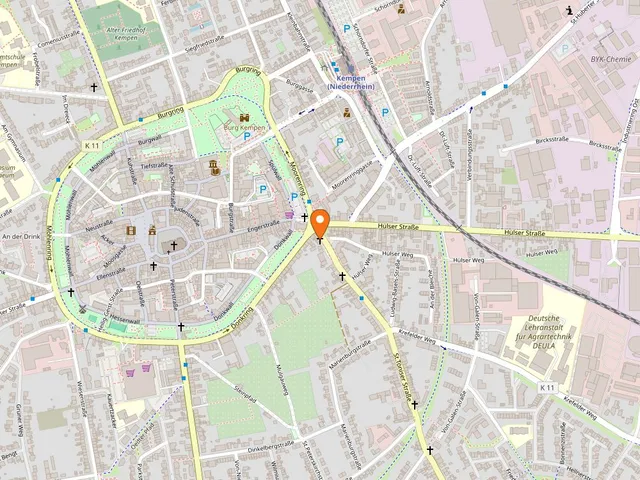
Blue dots: other places nearby — tap to explore.
Address
Dr.-Laakmann-Gasse 1
47906 Kempen
Hours
So: 00:00–24:00
You might also like — related or nearby
Comments
- Loading comments…
Sources & links
- Official website
- Wikidata (retrieved 2026-07-06)
- Wikipedia (retrieved 2026-07-06, rev 247922360)
- Official website (retrieved 2026-07-06)
- openstreetmap.org (retrieved 2026-07-06)
Auto-generated, last verified: 2026-07-06
How this page is made
This page draws on open sources — Wikipedia, Wikidata, official websites and the city’s open data. Every statement is checked against the sources linked here, and pages are refreshed regularly.
Spotted a mistake anyway? Tell us below — we read every submission.