St. Jakobus
Catholic parish church on the Main whose six bells form the diocese's heaviest peal after Würzburg Cathedral.
St. Jakobus is the Roman Catholic parish church of Miltenberg am Main, named after the apostle James the Elder.
At a Glance
- Type
- Roman Catholic parish church
- Location
- Miltenberg am Main (Bavaria)
- Style
- Neoclassical, Gothic at its core
- Layout
- Three-aisled gallery pseudo-basilica with three-sided apse
- Bells
- Six, distributed between the north and south towers
- Organ
- 32 stops, playable on three manuals and pedal
- Affiliation
- St. Martin parish community, Miltenberg deanery, Diocese of Würzburg
History and Building
A first church was built in the 13th century, when Miltenberg was granted town rights. A larger three-aisled building followed in the late 14th century, but was declared structurally unsound in 1782. The present neoclassical appearance dates from the 19th century, including the choir-flanking towers with their onion domes and lanterns. The interior was stripped back in 1959. During a major renovation in 2003/2004 the liturgical space was reshaped according to the reforms of the Second Vatican Council: the floor level was raised again, the choir's steps were altered, and a new altar island was installed, bringing the altar closer to the pews while the tabernacle found a place in a historic sacrament house.
Parish
The parish's filial churches are St. Josef in the Breitendiel district, St. Katharina in Mainbullau, and St. Vitus in Wenschdorf.
Furnishings
Entering from the west, visitors reach the baptismal area: beneath a massive wheel chandelier stands a 1608 shell-shaped font by Michael Juncker. Since 2004 the choir has featured a vividly colored, altarpiece-like painting by Clemens Kaletsch that can be opened and closed to change its scenes, depicting among other things the calling of James and John at the fishing boat, the raising of Jairus's daughter, the Garden of Gethsemane, and the request of Zebedee's wife to Jesus. The striking pulpit dates from 1635, by Zacharias Juncker the Elder. The north aisle holds an Adoration of the Magi group from around 1400, and the devotional chapel a Madonna in a halo of rays from the same period; the south aisle contains baroque figures of St. Nepomuk and St. James. Further treasures include an alabaster altarpiece of 1624 with seven scenes of Mary and a life-size late Gothic sandstone crucifix by Hans Backoffen. The outer walls of the aisles are lined with the Stations of the Cross created by Thomas Buscher in 1927, whose original coloring was lost during the 1959 renovation.
Organ
The case of the 1699 organ by builder Schleich survives intact. The organ itself was built in 2004 by the Vleugels workshop (Hardheim), reusing 13 stops from the previous instrument made by J. Bittner in 1935. It is a slider-chest organ with mechanical key action and electric stop action. Its effect stops include nightingale, cymbelstern, timpani, and cuckoo, as well as a trombone angel that, when turned, sounds a ship's horn known as the Bieber-Boom.
Good to Know
The six bells form the diocese's heaviest peal after Würzburg Cathedral's; the two largest hang in the north tower, the rest in the south. On 22 July 2006, then-parish priest Ulrich Boom had them rung for 20 minutes to drown out a demonstration by an NPD youth organization.
Gallery
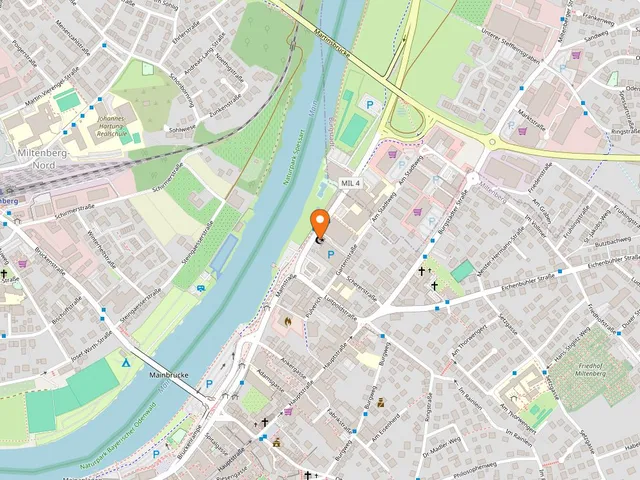
Map
Blue dots: other places nearby — tap to explore.
Address
Hauptstraße 166
63897 Miltenberg
You might also like — related or nearby
Comments
- Loading comments…
Sources & links
- Official website
- Official website (retrieved 2026-07-18)
- Wikidata (retrieved 2026-07-13)
- Wikipedia (retrieved 2026-07-13, rev 264330970)
- openstreetmap.org (retrieved 2026-07-13)
Auto-generated, last verified: 2026-07-13
How this page is made
This page draws on open sources — Wikipedia, Wikidata, official websites and the city’s open data. Every statement is checked against the sources linked here, and pages are refreshed regularly.
Spotted a mistake anyway? Tell us below — we read every submission.