Wallhausen (near Miltenberg)
A medieval deserted town on the river Main that lost out to nearby Miltenberg and survives today only as the foundations of a church tower.
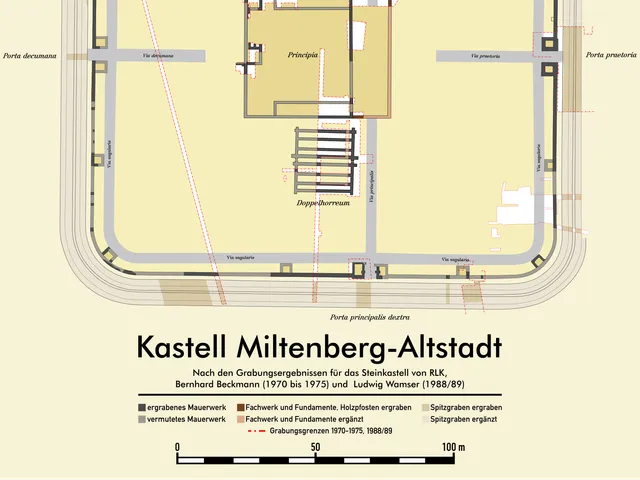
Only a few kilometres from Miltenberg once lay the medieval town of Wallhausen (also Waleshusen) – a town foundation that failed and has since vanished into the ground as a so-called deserted settlement. Built on the walls of a Roman fort, it was partly destroyed in 1237 and abandoned over the following decades.
Source: Wikipedia
At a Glance
- Type of site
- Medieval deserted town (abandoned settlement)
- Location
- On the river Main between Miltenberg and Kleinheubach, where the Mud flows into the Main
- Earlier history
- Built on the Roman fort of Miltenberg-Altstadt
- Town status
- Recorded as a „civitas" in 1229 and an „oppidum" in 1231
- Destroyed
- In 1237 during the so-called Lorsch Feud
- Notable for
- Being an example of a failed medieval town foundation
- Present condition
- Only the foundations of the church tower remain
Location and Importance
The site was well placed for traffic and trade: here the Mud joins the Main, and in the Middle Ages important routes crossed at this point – the road between Nuremberg and Frankfurt as well as the link between the Hohenstaufen imperial palaces of Wimpfen and Gelnhausen. The Romans had already fortified the strategic spot with a fort to protect the Nasser Limes.
In the High Middle Ages several territories met in the surrounding area: Wallhausen and Kleinheubach belonged to the Counts Palatine of the Rhine, Bürgstadt and Miltenberg to the Archbishopric of Mainz, Freudenberg to the Bishopric of Würzburg, while confidants of the Hohenstaufen royal house held sway in Klingenberg and Prozelten.
History
As early as the 6th and 7th centuries, the Franks laid out a small fortified base on the ruins of the Roman fort, traceable as a small stronghold with a flanking gate tower in the eastern corner of the former camp. In the 9th century this was replaced by a new fortification in the northern corner, and a royal court probably stood in the area of the former Roman principia.
From the 10th to the 11th century the place grew into a trading hub, above all for sandstone columns and sarcophagi. A tower castle emerged – probably the seat of the ministerial family „de Walehusen" – and outside the fort an unfortified settlement developed with its own church, which stood on the ancient Roman bathhouse.
At the start of the 13th century, Count Palatine Ludwig the Kelheimer had a town wall built on the foundations of the fort and developed Wallhausen into a town. The ancient gates were walled up and two new gates with a gatehouse were added. Archaeology has revealed houses leaning against the town wall, a merchant's house, craftsmen's kilns, a well and a fortified house. At the centre stood a church 26.1 metres long, surrounded by a cemetery, whose origins probably reach back to the early Middle Ages.
Decline
The end of Wallhausen was shaped by its rivalry with Miltenberg, which arose almost at the same time. Around 1200 the archbishops of Mainz had the Mildenburg castle built together with the town of Miltenberg – first mentioned in 1237 – to secure their territory against the palatine Wallhausen. A struggle lasting decades followed: in 1229 Count Palatine Ludwig I and his son Otto II pledged Wallhausen to the Mainz archbishop Siegfried II of Eppstein, and in 1231 the count had to return it.
In 1237/38 a stubborn conflict broke out between Otto II and the Archbishop of Mainz over Lorsch Abbey, Wallhausen and Bensheim – the so-called Lorsch Feud. In its course Wallhausen was partly destroyed in 1237. Under the settlement of 1247, Otto II received the advocacy over Lorsch Abbey and the village of Seckenheim as compensation; Wallhausen passed definitively to Mainz and was economically drained by Miltenberg. The contest between the two neighbouring town foundations ended with the victory of Electoral-Mainz Miltenberg, about two kilometres away. Kleinheubach also benefited from the decline: Wallhausen's parish rights were transferred to its church.
Today
Under the rule of Electoral Mainz the site remained loosely settled. In 1363 a small church, St. Walpurg, built by the Count of Rieneck, was mentioned; it belonged to the parish of Kleinheubach and was sold for demolition in 1770. Today the area of the former settlement lies between Miltenberg and Kleinheubach, partly built over by a farmstead and a railway line. In a meadow the foundations of the church tower still stand. Information boards explain the history of the ancient Roman fort – but not that of the medieval town. The names „Altstadtweg" and „Kastell Miltenberg-Altstadt" likewise recall that a town once stood here.
Map
Blue dots: other places nearby — tap to explore.
You might also like — related or nearby
Comments
- Loading comments…
Sources & links
Auto-generated, last verified: 2026-08-19
How this page is made
This page draws on open sources — Wikipedia, Wikidata, official websites and the city’s open data. Every statement is checked against the sources linked here, and pages are refreshed regularly.
Spotted a mistake anyway? Tell us below — we read every submission.