Museum Burg Miltenberg
Set inside the medieval Mildenburg above Miltenberg, this town-run museum has paired icons with modern art since 2011.
High above Miltenberg stands the Mildenburg, a castle dating from the mid-12th century that has housed the Museum Burg Miltenberg since July 2011. The castle and the museum belong together but are two distinct things: the medieval building itself and the collection installed within it.
At a Glance
- Castle built
- Spur castle, probably begun around 1144
- Oldest part
- 27-metre keep of rusticated ashlar stone
- Museum since
- July 2011
- Operator
- Town of Miltenberg (Museen Miltenberg)
- Collection
- Icons, modern art and Romanian reverse-glass icons
- Opening hours
- 16 March – 31 October, Tue–Sun 11am–4pm (closed in winter)
- Admission
- €8 (reduced €5, children up to 14 free) – combined ticket for both Miltenberg museums
- Address
- Conradyweg 20, 63897 Miltenberg
History of the Mildenburg
According to research by Wolfgang Hartmann, the Mildenburg was most likely built from around 1144 on a northern spur of the Greinberg, commissioned by King Conrad III and carried out by Burkard of the noble family of the Lords of Weinsberg. Having taken over the advocacy of Amorbach Abbey in 1144, Conrad had two castles built on the abbey's land: the Mildenburg and the Frohburg, forerunner of the Freudenburg. Their names express gratitude to the king and praise his mildness. The town's name Miltenberg also derives from the castle, combining the Middle High German milte (kind, generous) with bërc (hill, castle).
Around 1200, during the German throne dispute between the Hohenstaufen and the Welfs, the castle probably passed to the Archbishop of Mainz, Siegfried II of Eppstein. It is first documented as a Mainz fief under the name "Miltenburch" in 1248. For centuries it secured Mainz's power and toll station on the south-western Lower Main, serving until the 18th century as the seat of the archbishop's burgraves.
The Building and Its Destruction
The 27-metre keep, built of rusticated ashlar blocks, is the oldest part of the complex. It stands deliberately at the most vulnerable point, the slope rising to the south. The present residential building, with its tall roof and stepped gable, was erected between 1390 and 1396 under the Mainz archbishop Conrad of Weinsberg.
The castle was captured in the Peasants' War of 1525 and destroyed in 1552 during the Second Margrave War. Archbishop Daniel Brendel von Homburg (1555–1582) had it partly rebuilt. In 1803 it passed to the Prince of Leiningen and remained in private hands from 1807 to 1979 – owners included the von Normann-Loshausen and Bock von Wülfingen families. During this time the castle courtyard was given its 19th-century romantic-revival appearance. In 1979 the town of Miltenberg acquired the complex.
The Museum Today
Since July 2011 the restored castle has housed the Museum Burg Miltenberg as part of the Museen Miltenberg. Its heart is the encounter between icons and contemporary art, deliberately set in dialogue and contrast. Sixteen Greek and Russian icons from the 16th to 19th centuries speak to the human desire to make the transcendent present.
They are complemented by more than 200 works of the 20th and 21st centuries, donated to the museum by cathedral canon Dr Jürgen Lenssen. Around 80 artists are represented, among them Joseph Beuys, Sigmar Polke, Max Pechstein, Ernst Barlach, Michael Triegel and Ben Willikens.
Reverse-Glass Icons
A special focus lies on more than 180 Romanian reverse-glass icons from the collection of Dr Joachim and Marianne Nentwig, shown in three exhibition rooms – according to the museum, the largest collection of its kind in Germany. Unlike the Russian and Greek icons made by professional icon painters following strict rules, these were created by lay people in the 18th and 19th centuries in Transylvania, today's Romania. They were mass-produced, sold at fairs and by pedlars, and intended for private devotion at home rather than sacred spaces.
Your Visit
The museum is open from 16 March to 31 October, Tuesday to Sunday, 11am to 4pm; from 1 November to 15 March it is closed and accessible only by appointment for guided tours, workshops and children's birthday parties. Admission is €8, reduced €5 (young people up to 18, vocational students, seniors, people with severe disabilities, and from 3pm as a "Culture Happy Hour"); children up to 14 are free and a family ticket costs €15. The ticket is also valid for the Museum Stadt Miltenberg. Card payment is currently not possible.
Every level is reachable by lift, and an accessible toilet is available. There is no lasting parking directly at the castle, only drop-off space; car parks are a few minutes' walk away at the riverfront or along the Burgweg. From Miltenberg station it is about a 20- to 30-minute walk, and bus lines 80, 81, 82, 86 and 88 stop at Miltenberg Linde.
Map
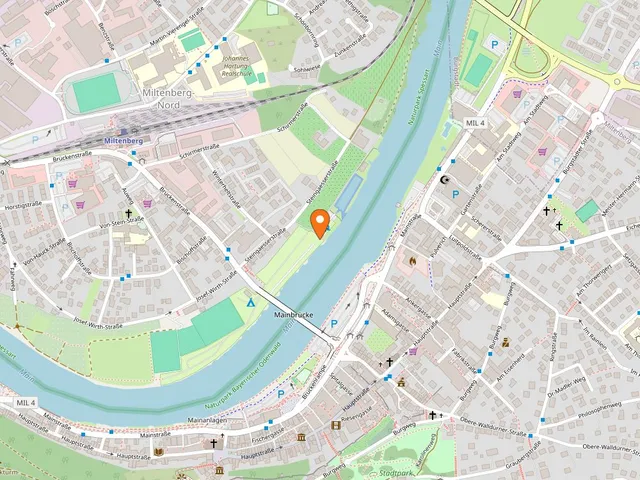
Blue dots: other places nearby — tap to explore.
Address
Conradyweg 20
63897 Miltenberg
Hours
Di: 10:00–16:00
Mi: 10:00–16:00
Do: 10:00–16:00
Fr: 10:00–16:00
Sa: 10:00–16:00
So: 10:00–16:00
You might also like — related or nearby
Comments
- Loading comments…
Sources & links
- Official website
- Official website (retrieved 2026-07-13)
- openstreetmap.org (retrieved 2026-07-13)
- Wikipedia (retrieved 2026-07-14)
Auto-generated, last verified: 2026-07-14
How this page is made
This page draws on open sources — Wikipedia, Wikidata, official websites and the city’s open data. Every statement is checked against the sources linked here, and pages are refreshed regularly.
Spotted a mistake anyway? Tell us below — we read every submission.