Miltenberg Hbf
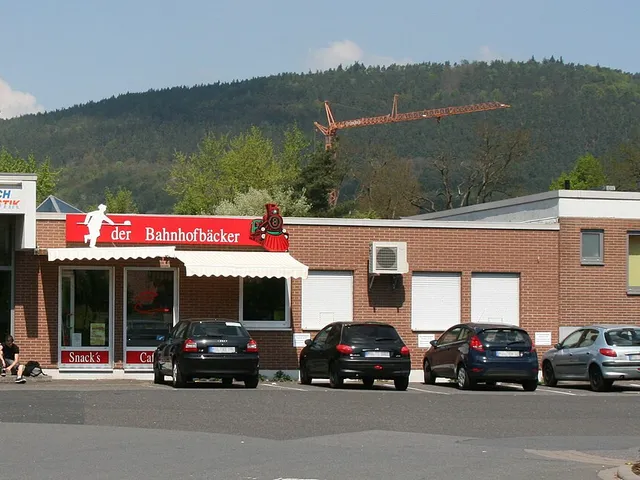
Opened in 1876 as Miltenberg's first station – a dead-end terminus whose layout forced through-trains into a switchback; today a commercial estate.
Miltenberg Hbf was the first railway station of the Bavarian town of Miltenberg, opening in 1876. As a dead-end terminus it permanently hampered operations and was replaced for passenger traffic in 1977 by Miltenberg Nord station on the right bank of the Main.
Source: Wikipedia
At a Glance
- Former type
- Terminus station, freight-only from 1977
- Today
- Commercial estate with shops and restaurants (since 2007)
- Opened
- 12 November 1876
- Location
- Narrow valley site on the left bank of the Main, near the old town
- First line
- Aschaffenburg–Miltenberg railway
- Passenger service ended
- 22 May 1977
- Freight service ended
- 20 December 2001
- Station building
- Listed as a cultural heritage monument under Bavarian law
Things to do here
History and Location
The route of the Ludwigs-West-Bahn initially bypassed Miltenberg. The site on the left bank of the Main was deliberately chosen so that an extension upstream toward Wertheim was impossible, and a continuation to Amorbach–Seckach would only work with a reversal of direction. Bavarian policy thus forfeited any wider regional significance for the station.
Operating as a Switchback
In 1880 a second line to Amorbach was added, and Seckach became reachable from 1899. The local line to Stadtprozelten opened in 1906; since part of the left bank belonged to Baden, it ran entirely along the right bank of the Main. Through trains between Wertheim and Aschaffenburg had to stop at Miltenberg Nord, pull forward toward Aschaffenburg, reverse back into the station, and then change direction again to continue – effectively a switchback operation. The connection to the Lauda–Wertheim line followed in 1912.
Replacement in Two Phases
From the 1950s onward, through express trains made these operating conditions untenable. Deutsche Bundesbahn opted for the "large solution" – relocating all facilities to Miltenberg Nord on the right bank – rather than the "small solution," which would only have moved passenger stops and freight handling. In March 1972 it released 1.45 million DM for a first construction phase: Miltenberg Nord was expanded, and from the 1972 summer timetable some through services became possible. A second phase followed in 1975, bringing a new station building, new freight facilities, and new platforms with an underpass. For cost reasons, the new station received only an older-style electromechanical signal box instead of a modern Dr-type system. Total costs came to 5 million DM. The now-obsolete facilities for locomotive servicing and the turntable were dismantled; the engine shed still stands and, as of 2020, serves as storage and office space for a scrapyard.
The Freight Yard
After passenger services moved away, the site continued as a freight yard that saw heavy use until the mid-1990s. It featured a loading road, several siding tracks, and a connection to the riverbank for transshipment to Main river shipping; freight wagons were also stored there, and the railway maintenance office was based on site. In 1990, signalling control passed to the dispatcher's office at the new station, and semaphore signals were replaced with light signals.
Decline and Redevelopment
From 1997, key customers – including a ceiling-tile manufacturer in Amorbach and a ceramics maker in Kleinheubach – shifted their transport to road haulage; DB withdrew its Köf III shunting locomotive, and the facilities were used only seasonally for timber loading. After the last regular freight train, the site was used at times to store maintenance trains, the entrance was closed off in 2005, and nature gradually reclaimed the grounds. In 2007 everything except the station building and freight office was demolished, and the site was converted into a commercial estate for shops and restaurants.
Station Building
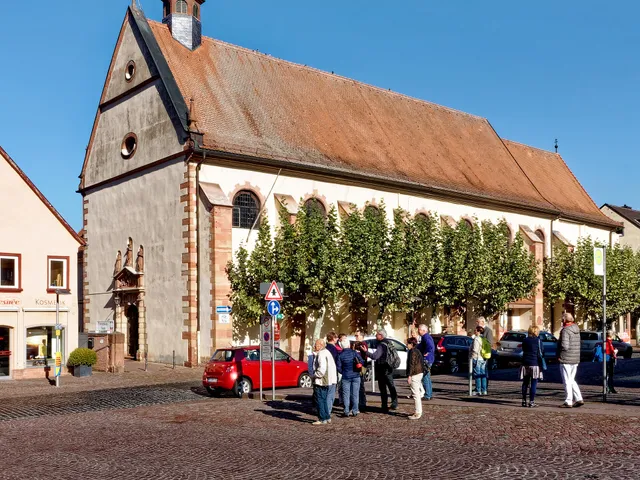
The late-classicist station building is faced with red Main sandstone. After the passenger station moved, it served the railway maintenance office and as housing for railway staff. In 1981 it passed to a private investor, who converted the flats into rental apartments.
Gallery
Map
Blue dots: other places nearby — tap to explore.
You might also like — related or nearby
Comments
- Loading comments…
Sources & links
Auto-generated, last verified: 2026-07-13
How this page is made
This page draws on open sources — Wikipedia, Wikidata, official websites and the city’s open data. Every statement is checked against the sources linked here, and pages are refreshed regularly.
Spotted a mistake anyway? Tell us below — we read every submission.