Jona Church, Wachtendonk
Protestant community centre on Berliner Straße, inaugurated and named in 1986 – the latest chapter in a centuries-long history of Protestant diaspora on the Lower Rhine.
since 1986
The Jona Church is the Protestant community centre of Wachtendonk. It stands on Berliner Straße in a newly developed residential area and belongs to the Protestant parish of Straelen-Wachtendonk.
At a glance
- Type
- Protestant community centre with parsonage, in a new residential development on Berliner Straße
- Inauguration
- 16 February 1986
- Naming
- ceremony on 13 July 1986 – together with the names of the parish's two other churches (Dietrich Bonhoeffer Church and Johannes Church)
- Parish
- part of the Straelen-Wachtendonk parish, led by a shared presbytery drawn from all three parish districts
- Predecessor
- a Bartning emergency church by the Nette (built around 1950/52, dismantled in 1986)
- Own pastorate
- a second pastorate for Wachtendonk since 1991
- On the name Jona
- several references in the furnishings, including an organ, a labyrinth and a depiction of "Jonah and the whale"
Age comparison
Age compared with other places in Wachtendonk.
Protestants in the diaspora
A Protestant presence in Wachtendonk reaches back to the 16th century, though it long remained marginal. During the Eighty Years' War, the preacher Engelbert Faber reported to the Count of Nassau in October 1578 that Geldern and Wachtendonk had adopted the Reformed confession; the preacher Peter Hackius, from Leiden, arrived with the troop of Gerrit de Jonge. In 1582 the Reformed faith was declared the only permitted one, and in 1583 the altars and images of the Catholic church were destroyed, along with the Nicholas chapel on the Schlot. Biblical inscriptions from that era came to light in 1874, beneath the whitewash, during a renovation of the parish church. Yet the Reformed interlude lasted only from 1578 to 1588: after the Spanish reconquest, no Protestants were tolerated during roughly 120 years of Spanish rule.
Protestants in Wachtendonk are mentioned again only in 1845, at the founding of the neighbouring Niederdorf parish – among them a justice of the peace and the physician Dr Frankenberg, who travelled long distances to worship in Niederdorf. In 1878 the almost entirely Catholic Wachtendonk even had a Protestant mayor (Pabst), which was possible because mayors were then appointed by the government in Düsseldorf rather than elected. How many Protestants actually lived in the town long remained unclear; Catholic farmers often did not want their neighbours to know that their farmhands and maids were Protestant. A service set up in a room of the town hall by Pastor Quaas in 1934 was discontinued after about a year for lack of attendance.
Emergency church by the Nette
After 1945 the situation changed fundamentally: many refugees and displaced people came to Wachtendonk, most of them Protestant. From 20 October 1946 onwards, with the support of the Catholic community, services were held first in the Catholic youth hall and later in the largest classroom of the Catholic school, attended by 120 to 150 people each Sunday. In the long run this was not enough. Pastor Schauss and the presbytery searched for a building plot, a task made difficult by the opposition of part of the Catholic population. In August 1950 the plot cost 4,500 marks, of which the community itself raised 1,000 marks while other congregations helped out; the seller insisted on cash payment. From the outset the plan was not for a "church" but for a "community centre" with several rooms for group work.
Around 1950/52 a "Bartning emergency church" was built near the Nette – a standardised timber structure designed by the architect Otto Bartning, who called such buildings "true churches of spiritual and material need". For small, financially weak diaspora congregations he developed a reduced version, the "diaspora chapel"; production was organised by the Protestant relief agency and co-financed by churches abroad. At full capacity such chapels held fewer than 200 people. The altar niche could be closed off so that the sanctuary became a parish hall; there was also a separate room for youth and community work and a small emergency flat for the catechist. Forty-eight of these diaspora chapels were erected across Germany, including nearby ones in Kevelaer and Vorst. After 34 years the Wachtendonk emergency church was dismantled in 1986 and handed over to the Catholic St Boniface community in Hagen-Haspe, where it serves today as the "Lioba Chapel".
New building and naming
The construction of the A40 motorway towards Venlo in the mid-1970s signalled coming population growth, including among Protestants. In response, the present community centre and parsonage were built in Wachtendonk's new residential development and inaugurated on 16 February 1986. The church received its name only a few months later: at a ceremony on 13 July 1986 all three churches of the Straelen-Wachtendonk parish were named – the Jona Church in Wachtendonk together with the Dietrich Bonhoeffer Church and the Johannes Church.
Until 1991 a single pastorate served the three parish districts of Straelen, Niederdorf and Wachtendonk, supported by a lay preacher from 1982. In 1991 Wachtendonk gained its own second pastorate. Since the fresh start after 1945, parish life has been led by a shared presbytery with members from all three districts. Several furnishings allude to the name Jona, among them an organ, a labyrinth and a depiction of Jonah and the whale.
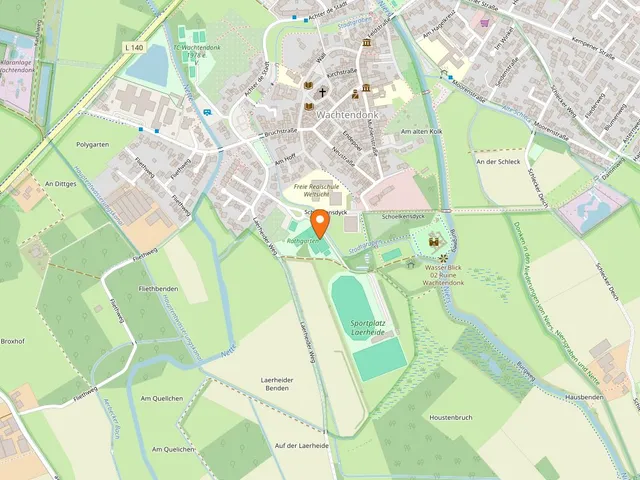
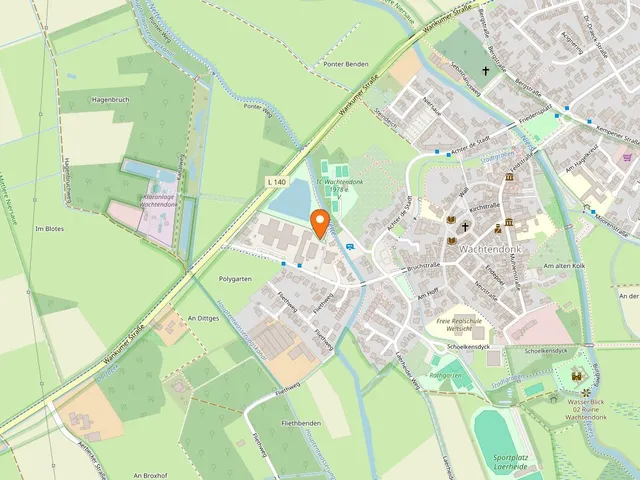
Map
Blue dots: other places nearby — tap to explore.
Address
Berliner Str. 12
47669 Wachtendonk
Hours
Mo: 08:00–17:00
Di: 08:00–17:00
Mi: 08:00–17:00
Do: 08:00–17:00
Fr: 08:00–12:30
You might also like — related or nearby
Comments
- Loading comments…
Sources & links
- Official website
- Official website (retrieved 2026-07-04)
- Official website (retrieved 2026-07-04)
Auto-generated, last verified: 2026-07-11
How this page is made
This page draws on open sources — Wikipedia, Wikidata, official websites and the city’s open data. Every statement is checked against the sources linked here, and pages are refreshed regularly.
Spotted a mistake anyway? Tell us below — we read every submission.